Fraud Detection and Prevention: A Merchant Playbook
Reported consumer losses from fraud passed $12.5 billion in 2024, a 25% increase on the year before, according to the FTC's 2024 Consumer Sentinel data. The same release reports that about 38% of people who filed a fraud report said they lost money, up from 27% in 2023, and that the median loss was $497. More reports are turning into real money leaving real accounts.
Treat fraud detection and prevention as one system you can inspect, tune and measure. A checkbox at checkout isn't a strategy. The stores that lose least shorten the gap between a strange signal and a decision, then feed that decision back into the next rule. False declines get equal billing here with fraud losses, because a rejected buyer never appears in a chargeback report.
Table of Contents
- How Fraud Detection and Prevention Fit Together
- Fraud Types in Online Stores and Their Warning Signs
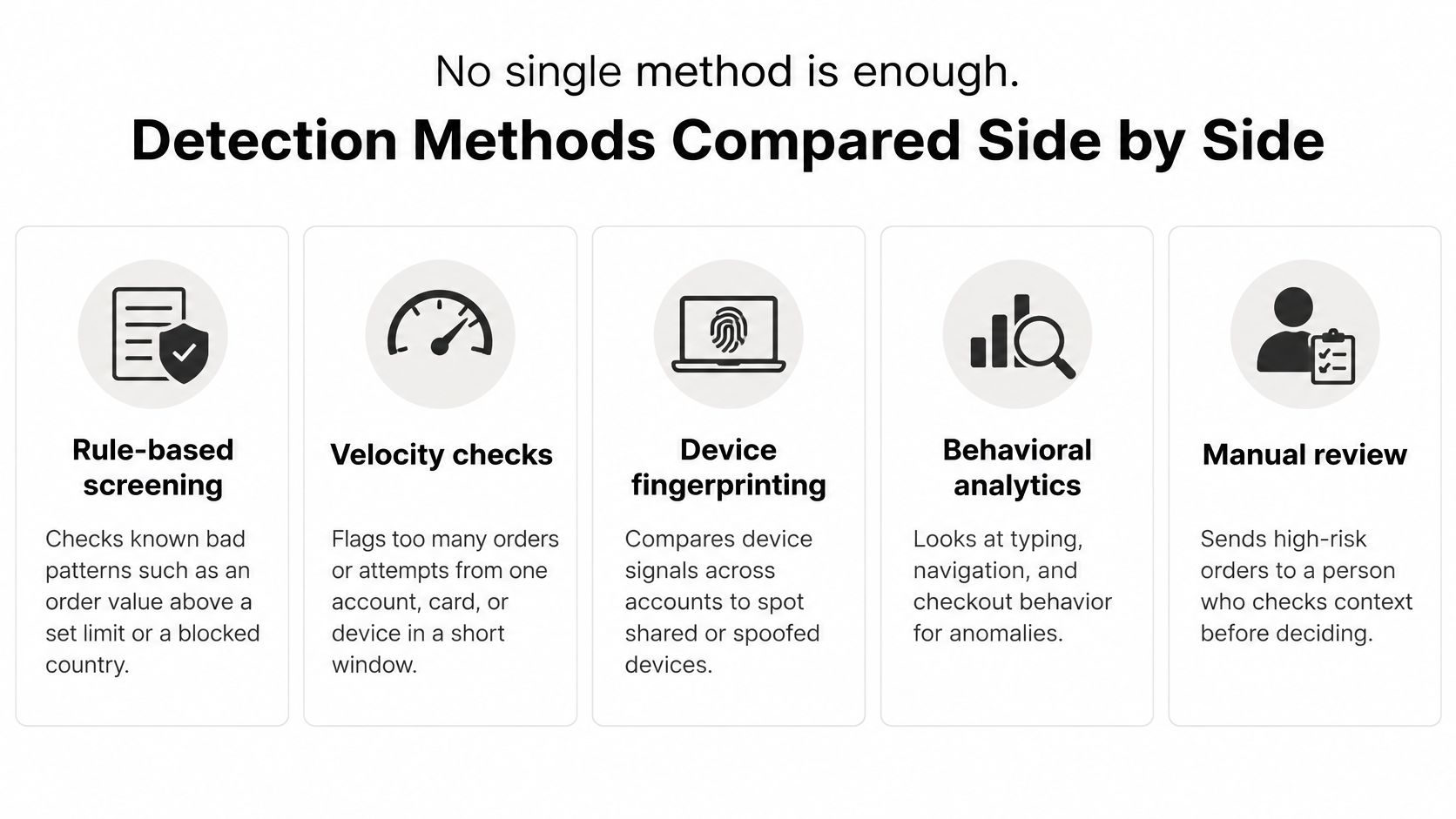
- Detection Methods Compared Side by Side
- How to Build a Layered Risk Score
- Metrics That Balance Fraud Losses and False Declines
- How to Review Suspicious Orders Without Losing Customers
- Compliance Considerations for Fraud Controls
- Confirm Your Fraud Stack This Week
<a id="how-fraud-detection-and-prevention-fit-together"></a>
How Fraud Detection and Prevention Fit Together
A scheme that runs for a year costs far more than one caught in a month. The ACFE 2024 Report to the Nations found the typical fraud scheme stayed undetected for 12 months, and duration drove the damage. Cases discovered within six months had a median loss of about $30,000; schemes lasting two to three years produced a median loss of $250,000; those running five years or longer reached $875,000. The same report estimates organizations lose roughly 5% of annual revenue to fraud.
Now split the work in two. Detection is the smoke alarm. It watches orders, accounts, sessions and payment attempts and tells you something is smouldering. Prevention is the fire door, the sprinkler and the exit plan: verifying identity, holding an order before fulfilment, capping promo use, refusing a payment, closing an account. One without the other is useless. A perfect alarm with no fire door just tells you where the building burned.
<a id="the-loop-that-turns-alerts-into-rules"></a>
The loop that turns alerts into rules
Detection feeds prevention, and prevention results feed back into detection. An order you held and then confirmed as fraud should raise the weight of every signal it carried. An order you held that turned out to be a nervous first-time buyer using a corporate card should lower it. Run that loop for a few months and your rules start reflecting your actual customers instead of a generic template.
Skip the loop and you get the opposite: rules written once, never revisited, rejecting good buyers while new attack patterns walk straight past.
The practical rule: every hour between a strange signal and a human decision is an hour where money can still leave.
<a id="why-occasional-reviews-fall-behind"></a>
Why occasional reviews fall behind
Manual spot checks worked when fraud was one person with one stolen card. Attacks are automated now. A script can test dozens of card numbers across a store in minutes, and a manual review that runs on Tuesday mornings will never see it. The ACFE report found that tips surfaced 43% of cases, and more than half of those tips came from employees. Your support rep who notices the same address on four accounts is a detection channel. Give that observation somewhere to go.
<a id="fraud-types-in-online-stores-and-their-warning-signs"></a>
Fraud Types in Online Stores and Their Warning Signs
Six patterns account for most of what a Shopify merchant will meet, and each one needs a different response. Treating them all as "fraud" and applying one blunt rule is how stores end up blocking loyal customers while the actual loss slips through under a different label.
Fraud types, warning signs and first responses
| Fraud type | Typical pattern | Early warning signs | First response |
|---|---|---|---|
| Card-not-present fraud | Stolen card details used on a new checkout | Billing and shipping addresses differ; several cards tried in a row | Hold for verification before shipping |
| Account takeover | Attacker logs into a real customer account | Login from a new device; email changed before the order; saved card used from an unusual location | Force a password reset and step-up verification |
| Friendly fraud | Customer disputes a valid purchase or claims non-receipt | Repeated disputes from one account; disputes on orders delivered to the address on file | Keep delivery proof and the full order timeline for the dispute |
| Refund and return abuse | Serial returns, wardrobing or false damage claims | Frequent returns; high-value refund requests on low-value orders | Review return history and limit returns for flagged accounts |
| Promo and policy abuse | Multiple accounts reuse first-order discounts or coupons | Several accounts from one device or address; codes shared publicly | Limit one code per customer and link accounts by device |
| Wholesale order fraud | Fake business account requests credit terms for a large order | New company name; mismatched tax ID; rush shipping to a new address | Verify the company and confirm with a known contact before approving terms |
<a id="why-combinations-beat-single-flags"></a>
Why combinations beat single flags
Signs rarely arrive alone, and that's where manual review goes wrong. A new device on its own means nothing. Plenty of honest people buy from a work laptop they've never used before.
Three signals lined up is a different story. Say an account's email changes at an odd hour, a saved card appears from a country the customer has never ordered from, and the order ships to a freight forwarder. Any one of those is noise. Together they describe a takeover in progress.
Read the pattern, not the flag. One unusual signal buys a second look. Three unusual signals buy a hold.
The same logic separates friendly fraud from genuine delivery failure. A customer who disputes once after a carrier shows "delivered" to the address on file may be unlucky. A customer whose last four orders each produced a dispute is running a process, and the response is a return-history limit, not another reshipment.
For wholesale accounts, the check is human. Call the number you already have on file for that company, not the number on the new application, and ask for the person you've dealt with before. A fake business account collapses the moment someone answers a phone.
<a id="detection-methods-compared-side-by-side"></a>
Detection Methods Compared Side by Side
Here's the principle that saves merchants the most money: no single method is enough. Each one sees a different slice of the session, and each has a blind spot that a determined attacker will find. The useful question isn't which method is best. It's which combination catches your actual losses without punishing your actual customers.
Detection methods compared
| Method | What it catches | Main weakness | Best fit |
|---|---|---|---|
| Rule-based screening | Known bad patterns such as order value over a set limit or a blocked country | Misses new attack patterns until someone writes a rule | Stores starting out or with clear policies |
| Machine learning scoring | Subtle combinations of signals across many orders | Needs labeled history and regular tuning | Stores with thousands of orders a month |
| Behavioral analytics | Unusual navigation, cart edits or checkout paths before purchase | Can flag unusual but honest shoppers | Stores where account takeover or cart abuse is common |
| Device fingerprinting | The same device behind many accounts or cards | Browser changes and privacy settings reduce accuracy | Promo abuse and account sharing |
| Real-time monitoring | Activity as it happens, so teams can act before checkout completes | Only as good as its signals and the staff reviewing them | Assisted checkout and high-value carts |
<a id="where-each-method-breaks-down"></a>
Where each method breaks down
Rule-based screening is the easiest to explain to a team and the easiest to audit. It's also the method that rots fastest. Add a rule for every incident and you end up with forty overlapping conditions nobody can reason about, flagging legitimate orders in bulk.
Machine learning scoring weighs many signals at once and finds combinations a person would never write down. It needs two things most small stores don't have: a few thousand labeled orders and someone who retunes the model as buying behaviour shifts.
Behavioral analytics catches takeover well, because an attacker moves through a familiar account in unfamiliar ways: fast navigation, repeated cart edits, a checkout path that skips the product page entirely. It also flags the honest shopper who is unusual.
Device fingerprinting links accounts, cards and sessions to the same physical device, which is what breaks promo abuse and account sharing rings. Browser privacy changes and extensions erode its accuracy over time, so treat it as one strong signal rather than a verdict. It's worth understanding how device fingerprinting actually identifies a device before you build rules on top of it.
Real-time monitoring only helps if a person is watching and able to act. A live dashboard nobody opens is decoration.
<a id="the-combination-most-stores-end-up-with"></a>
The combination most stores end up with
Start with rules as a baseline for the things you will never allow: blocked countries, absurd order values, repeated failed payment attempts inside a short window. Layer scoring on top to catch the combinations rules can't express. Add monitoring for the carts where a human decision still beats an automatic one, usually high-value and assisted checkouts.
Then check the whole stack monthly and ask one blunt question about each method: who reviews what this method flags? The weakest control in any store is the one with no owner.
<a id="how-to-build-a-layered-risk-score"></a>
How to Build a Layered Risk Score
NIST's Digital Identity Guidelines treat fraud prevention as layered risk management rather than a single authentication check. The guidance recommends controls including automated-attack detection, transaction analytics, device or account-tenure checks, mailing-address checks, fraud indicators and device fingerprinting, and it emphasizes phishing-resistant authentication built on cryptographic protocols so an impostor verifier can't harvest usable credentials.
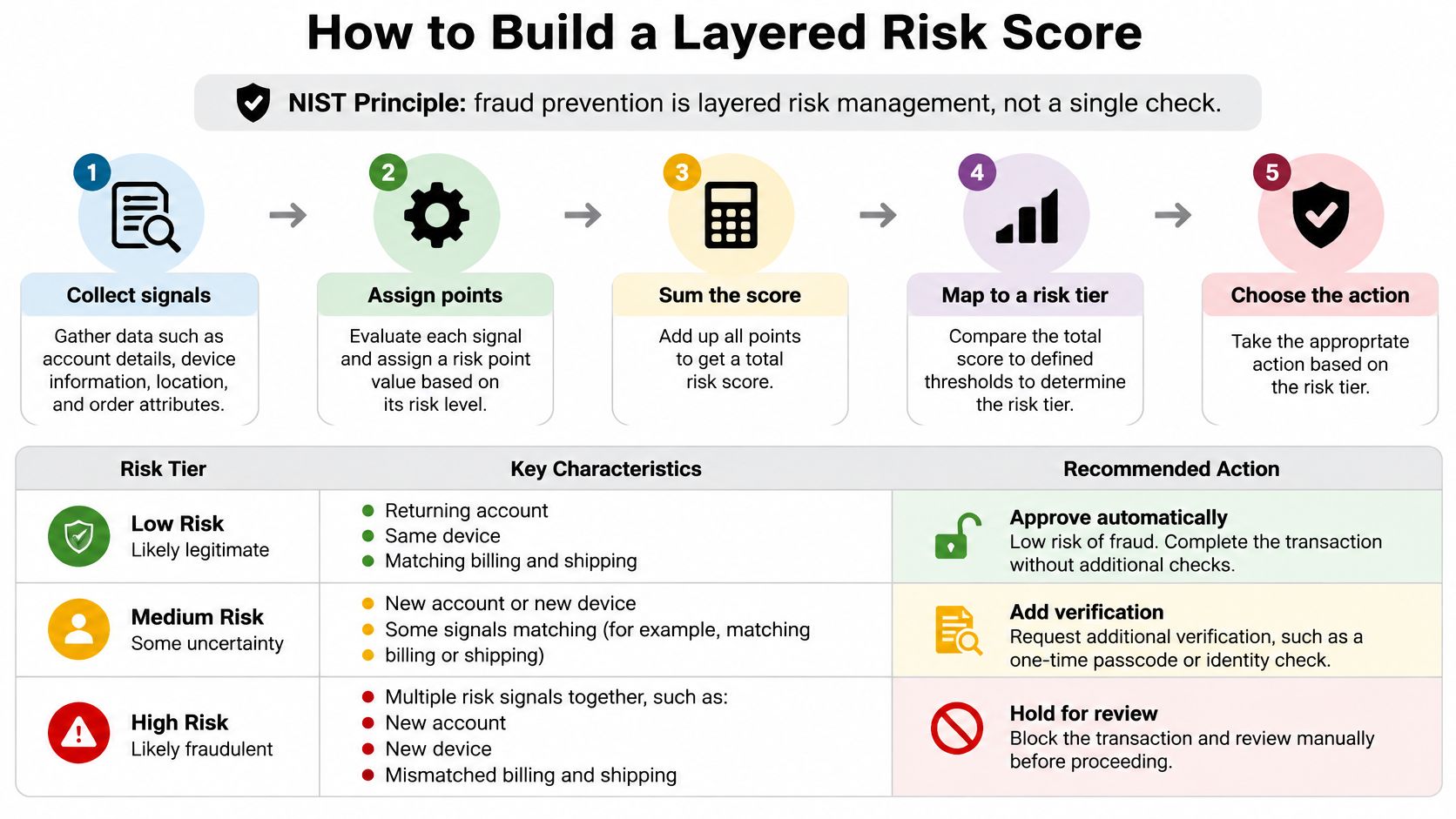
The operational idea is simple. Combine signals across identity, authentication, device, session and transaction layers, then respond in proportion: allow low-risk activity, step up verification for medium risk, hold or manually review high risk.
<a id="set-three-tiers-before-you-set-any-rule"></a>
Set three tiers before you set any rule
| Tier | Typical signals | Response |
|---|---|---|
| Low risk | Returning account, same device, billing and shipping match | Approve automatically |
| Medium risk | New account or new device with some signals matching, several failed card attempts | Step-up verification such as a one-time code or a support call |
| High risk | Several cards from one device, account details changed minutes before purchase, mismatched billing name | Hold for review before fulfilment |
Three tiers is enough. Five tiers sounds rigorous and produces arguments about which tier an order belongs to instead of decisions about the order.
<a id="build-the-score-in-five-steps"></a>
Build the score in five steps
-
List what you can observe. Account age, device continuity, network reputation, shipping and billing mismatch, attempt velocity, refund history, and any change made in the minutes before payment. If you can't see a signal reliably, leave it out rather than guessing at it.
-
Weight each signal against outcomes. Compare confirmed fraud against orders you know were legitimate, and score the signals that separate them. A signal that appears equally in both groups is noise, however suspicious it feels.
-
Set thresholds for the three tiers. Pick the score boundaries from your own order history, not from a vendor's default. Defaults are built for someone else's catalogue, price point and customer mix.
-
Attach exactly one response to each tier. Approval, step-up or hold. If a tier can trigger four different things depending on who is working, you have a mood, not a control.
-
Recalibrate monthly. Review false positives and confirmed fraud together, adjust weights, and re-test. Scores drift as buying behaviour changes.
Keep actions reversible where you can. A hold can be released and the order completed. A cancelled account and a burned customer are harder to walk back.
NIST also frames privacy assessment as part of deploying fraud tools rather than an afterthought, which is why the decision records, retention limits and access rules in the next sections belong in the design, not the audit.
<a id="metrics-that-balance-fraud-losses-and-false-declines"></a>
Metrics That Balance Fraud Losses and False Declines
A fraud team judged only on stopped fraud will stop too much. Every rejected good order is revenue that never appears in a fraud report, which is exactly why the loss stays invisible and the rule stays in place.
The scale of that blind spot is measurable. The 2025 Global eCommerce Payments & Fraud Report found that about 6 in 10 merchants reported false-positive rates between 2% and 10%, while 14% reported rates above 10%. Read that again from a shopper's side: at the top of that range, one in ten legitimate buyers gets turned away.
Fraud metrics to read together
| Metric | What it shows | Watch for |
|---|---|---|
| Approval rate | Share of orders accepted | A rising rate can hide fraud slipping through |
| Confirmed fraud rate | Share of orders later confirmed as fraud | Lags behind orders; measure after the chargeback window |
| False-decline rate | Share of legitimate orders wrongly rejected | Often unmeasured, so lost sales stay invisible |
| Manual review time | Minutes from flag to decision | Slow reviews lose buyers who then leave |
| Post-order loss | Refunds, chargebacks and write-offs per 100 orders | Losses often appear only after shipment |
<a id="how-to-read-the-five-numbers-together"></a>
How to read the five numbers together
Confirmed fraud falling is good news only if the false-decline rate didn't rise by more than you saved. Approval rates climbing is a warning sign until you know whether riskier orders are getting through. Review time creeping up tells you the queue needs a second pair of hands, not that fraud is rising.
Look at the five together, by customer segment, country, device type and B2B buying pattern, before you change a rule. One rule can look excellent in aggregate while punishing every international buyer you have.
<a id="the-four-profiles-your-rules-keep-catching"></a>
The four profiles your rules keep catching
First-time shoppers have no history, which is not the same as bad history. International buyers trip country rules built from a domestic customer base. Corporate-card purchases fail address checks because the card's billing address belongs to a finance department. Unusually large quantities look like reseller fraud until you learn the customer runs a small chain.
A confirmation email or a quick call resolves most of these in minutes. Rejection resolves nothing and costs you the order.
Log every verification you run, whatever the outcome, so the false declines can be counted later. An unrecorded verification is a lesson you paid for and didn't keep.
<a id="how-to-review-suspicious-orders-without-losing-customers"></a>
How to Review Suspicious Orders Without Losing Customers
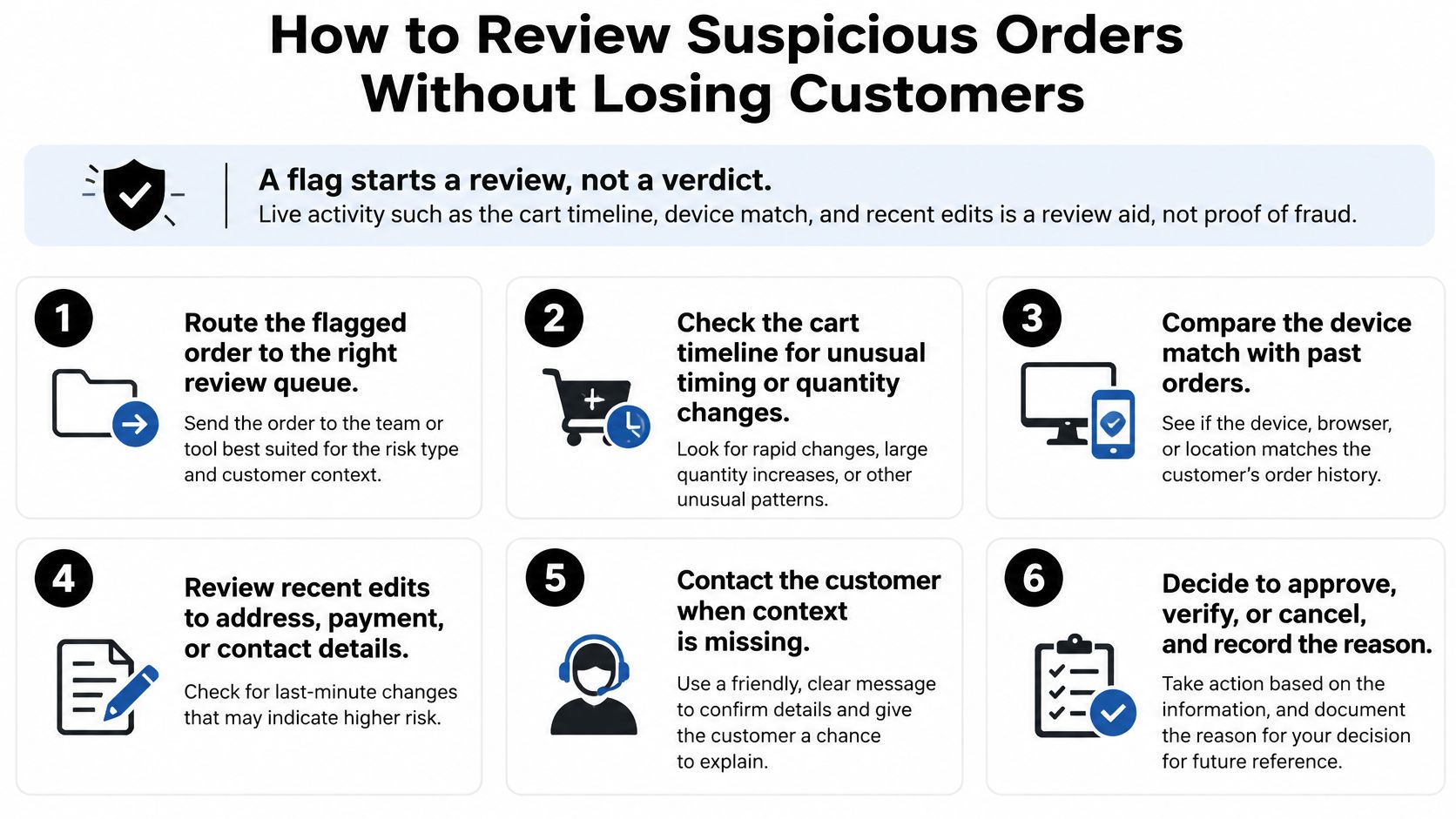
A flag starts a review, not a verdict. Live activity, including the cart timeline, the device match and the edits made in the last few minutes, is a review aid that helps you ask a better question. It is not proof of fraud, and treating it as proof is how support teams start cancelling orders from real customers.
Post-purchase risk is part of the same picture. The Visa Acceptance fraud report overview cites Adyen's finding that fraudulent chargeback losses on its global platform decreased 20% in 2025, while the average value of a fraudulent dispute fell 23%. Aggregate losses improving while lower-value, higher-volume abuse keeps arriving is exactly the shape of modern fraud: smaller disputes, more of them.
<a id="six-steps-from-flag-to-decision"></a>
Six steps from flag to decision
-
Route the order to one queue with a clock on it. A two-hour decision target for in-stock orders keeps holds from stalling good buyers. Two queues means two standards.
-
Check the cart timeline, device match and recent changes against the customer's history. A cart built over forty minutes reads differently from five carts abandoned in four minutes.
-
Contact the customer through a known channel and ask one clarifying question. Not an accusation. "Can you confirm the delivery address on this order?" gets answered. "We think this order may be fraudulent" gets a refund request.
-
Decide to release, hold or cancel, and write down why. The reason is what lets the next person handle a similar order without guessing.
-
Log the outcome when it arrives. Dispute, refund, clean delivery. A decision without an outcome teaches you nothing.
-
Review refunds, returns and disputes monthly. Repeated refund requests, serial returns, coupon misuse and support threads that keep seeking exceptions all belong in this review, not in the moment.
That monthly review is where pre-purchase signals prove their worth. If carts with three-plus edits and a new device ended in disputes far more often than average, the score was right. If they didn't, you've been holding honest buyers for nothing. Linking cart history to these outcomes is also a useful way to run suspicious activity monitoring without collecting data you never use.
<a id="compliance-considerations-for-fraud-controls"></a>
Compliance Considerations for Fraud Controls
Fraud controls touch payment data and customer behaviour, so they carry obligations that sit right next to the rules.
Keep card data out of your own systems. Don't store full card numbers or security codes, and let your payment provider hold them in its tokenized, PCI DSS-scoped environment. A custom checkout field that captures card details moves all of that scope onto you.
Work with strong customer authentication, not around it. In the EU and UK, some payments require a second factor, so design step-up verification to sit inside the 3-D Secure flow rather than bypassing it.
Treat device and behavioural data as personal data. Under GDPR-style rules, state why you collect each signal, keep it only as long as the review needs it, and restrict access by role. Your data security and privacy compliance posture applies to fraud tooling exactly as it applies to marketing data.
Document every automated decision and manual hold with its reason, so a customer or a regulator can get an explanation months later.
Check each rule for uneven impact. If a tier flags one country or customer group far more than others without a matching fraud pattern, change the rule, not the customers.
Align retention with the dispute window. Chargeback rules set how long you must be able to produce delivery proof, so keep order and delivery records at least that long.
<a id="confirm-your-fraud-stack-this-week"></a>
Confirm Your Fraud Stack This Week
You don't need a new platform to start. You need ninety days of your own data and one rule to tune.
-
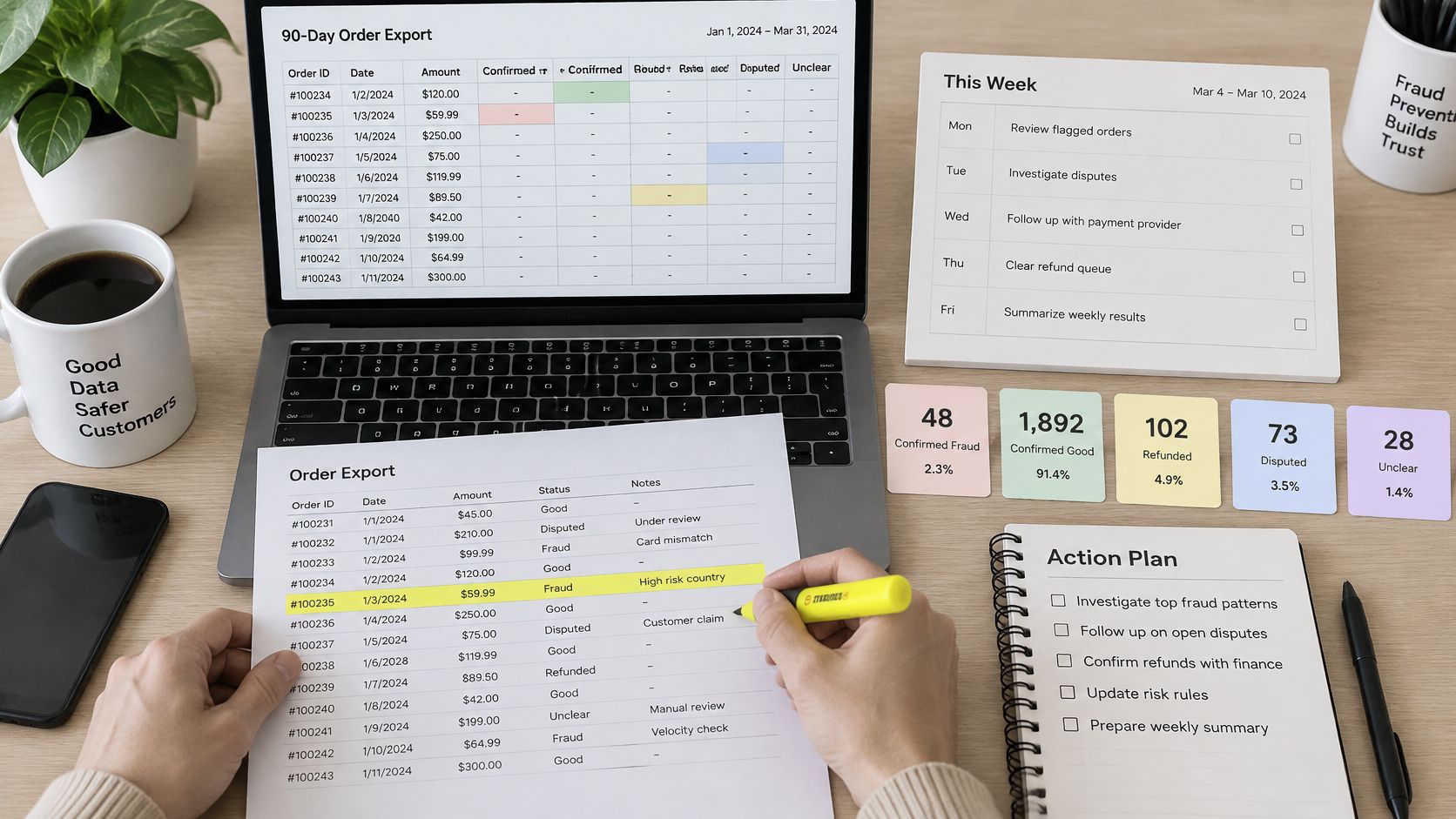
Export the last 90 days of orders and label each one as confirmed fraud, confirmed good, refunded, disputed or unclear. The unclear pile is your real to-do list.
-
Calculate the five metrics and record your false-decline rate before you touch a single rule. Without that baseline you can't tell improvement from movement.
-
Pick one medium-risk rule to tune, such as a shipping and billing mismatch, and test it against the past orders you just labeled. If it would have caught no fraud and blocked good buyers, retire it.
-
Set a review time target and name one owner for the flagged queue. A shared queue with no owner is a queue nobody clears.
-
Add live cart monitoring to the workflow. Cart Whisper | Live View Pro fits here as a review aid: it tracks live visitors, cart changes, page visits, searches and UTM sources, and it can set alerts for high-value idle carts. Its Cart ID view lets your team open a customer's exact cart before answering a question or cancelling an order.
After two to four weeks, rerun the metrics. Keep the tuned rule only if confirmed fraud fell without false declines rising by more. That test, repeated, is what a working fraud program looks like.
Cart Whisper | Live View Pro gives your team a live view of what shoppers are doing, from the products they add and remove to the exact point where a checkout stalls, so a flagged cart gets checked against real behaviour instead of a hunch. Its Cart ID view opens that customer's exact cart during a support conversation, and alerts for high-value idle carts keep an expensive order from slipping away. Add it to your review workflow by visiting Cart Whisper | Live View Pro on the Shopify App Store.